White Paper
Face Identification System Using AuraFace and FAISS
A scalable, client-server face-search system that finds a person across large photo collections from a single reference image — no per-person model training required.
Executive Summary
As part of a customer-driven requirement to quickly identify and retrieve photographs of a specific person from large collections of event and workplace images, NKORR developed a solution to address the challenges associated with manual image search. The existing manual search process was time-consuming and inefficient, especially as the volume of photographs increased.
To address this requirement, NKORR developed a Face Identification System that allows users to upload a reference image and find matching photographs without training a separate model for each person.
The solution uses AuraFace to generate facial feature embeddings and FAISS for fast similarity-based search across the indexed image collection. FastAPI powers the backend services, while Angular provides the user interface.
The solution enables efficient, scalable, and automated person-based image retrieval while significantly reducing the manual effort involved in searching large image collections.
Problem in Context
Organizations routinely capture thousands of photographs during a person’s onboarding, corporate events, training sessions, conferences, and team-building activities. Over time, these images accumulate into large repositories that are difficult to organize and search efficiently. Retrieving images of a specific individual manually is often time-consuming and labor-intensive.
Conventional approaches, such as organizing images by filenames, folders, or manually assigned tags, are difficult to maintain and do not scale as image collections grow. Manual tagging is both time-consuming and prone to human error, while many existing consumer-oriented facial recognition solutions depend on cloud-based services or are not designed to meet enterprise requirements for privacy, customization, and integration.
Organizations therefore require an intelligent, scalable, and secure solution that can automatically identify individuals across large image collections without relying on manual metadata. By leveraging advances in artificial intelligence, facial embeddings, and vector similarity search, all the photographs can be indexed and searched based on facial features rather than filenames or tags. This enables fast, accurate, and automated image retrieval while significantly reducing manual effort and improving the overall accessibility of organizational photo repositories.
Technical Deep Dive
System Architecture
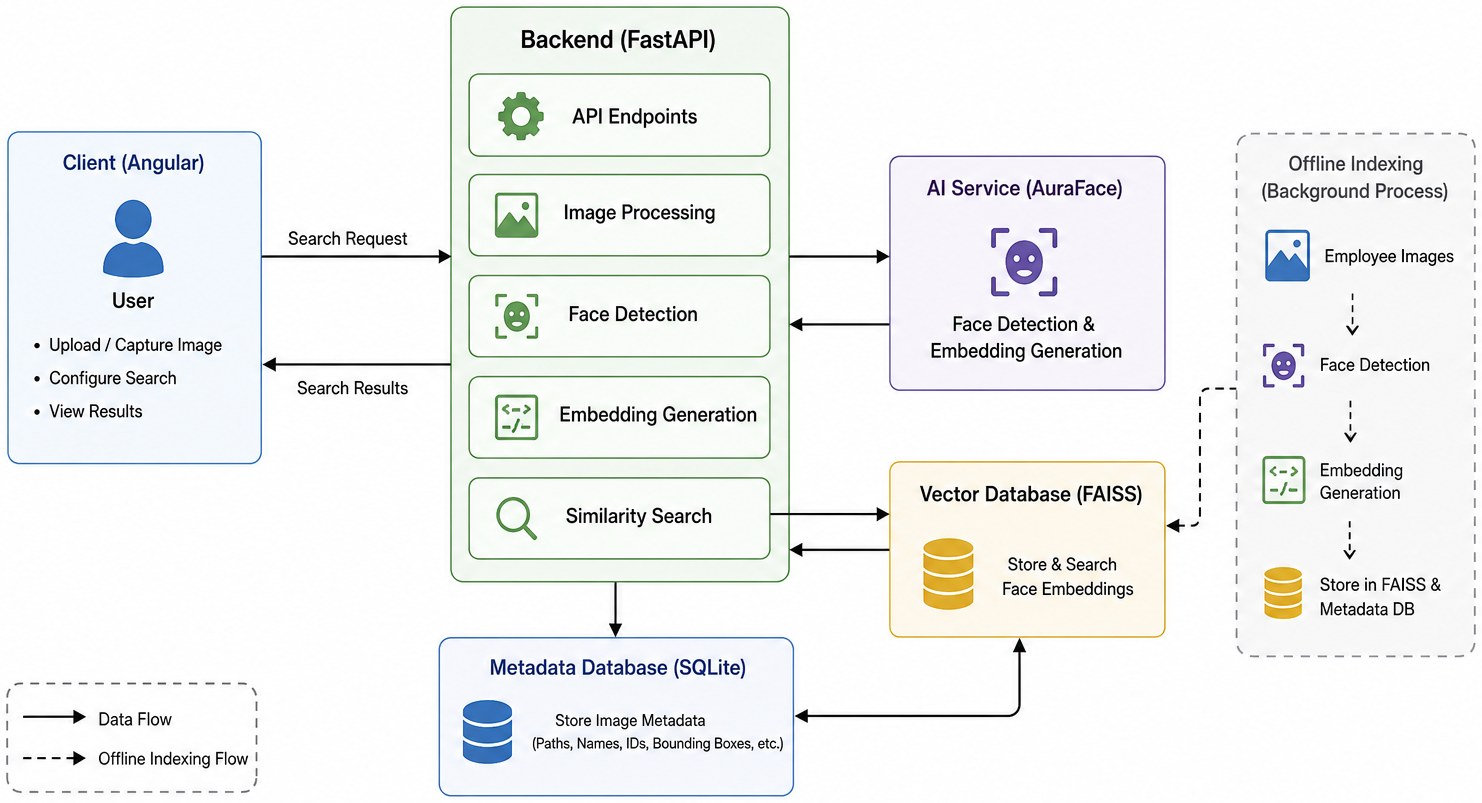
Face Detection and Embedding Generation
Offline Indexing
Similarity Search
Backend Services
Frontend Interface
System Workflow
The system separates offline indexing from online searching to optimize performance. All photographs are indexed once to generate facial embeddings and construct the FAISS index. During a search, only the uploaded query image is processed, significantly reducing response time and enabling efficient retrieval even for large image collections.
This architecture provides a scalable and efficient facial image retrieval platform that combines deep learning-based face representation with high-performance vector similarity search, making it suitable for enterprise-scale image management.
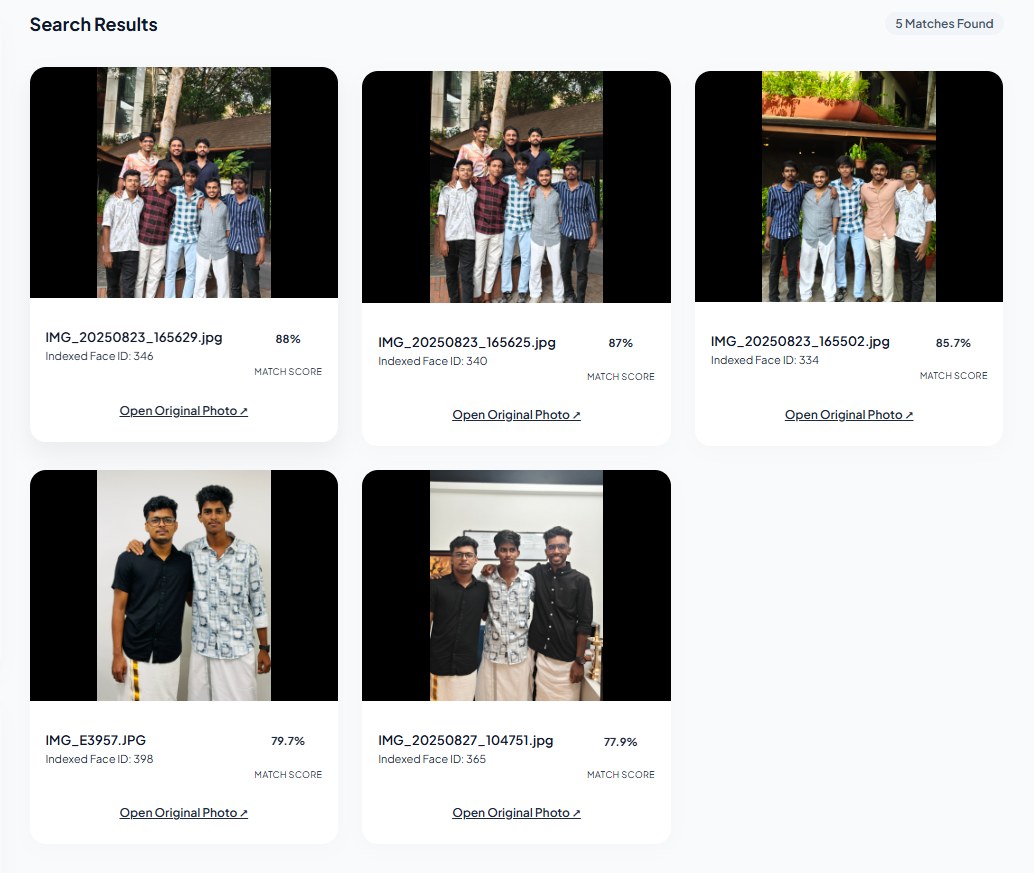
Results

Limitations
While the system is designed to provide efficient face-based image retrieval, identification performance can vary depending on image quality and capture conditions. Challenging scenarios such as partial face occlusion, masks, extreme lighting conditions, significant pose variations, low-resolution images, and blurred or partially visible faces may reduce matching reliability. Visually similar individuals, including twins or people with similar facial characteristics, may also result in incorrect matches.
The system relies on similarity thresholds to determine whether a detected face should be considered a match. An inappropriate threshold may increase false-positive matches or exclude valid matches. Therefore, threshold values should be calibrated and validated using representative images from the intended deployment environment.
The current implementation is a proof of concept and does not establish performance guarantees across all possible operating conditions. Further evaluation using representative datasets and edge-case scenarios would be required before production deployment, particularly where incorrect identification could have significant consequences.
Recommendations
- Incremental indexing to add new photographs to the FAISS index without rebuilding the complete dataset.
- Similarity threshold calibration using representative images to balance false matches and missed matches.
- FAISS index optimization as the number of stored face embeddings increases, balancing search speed and accuracy.
- Model and index versioning to ensure embeddings remain consistent when the AuraFace model or configuration changes.
- FAISS–SQLite synchronization to maintain reliable mapping between face embeddings, source images, face IDs, and bounding boxes.
Authors & Contributors


References
| # | Source | Notes |
|---|---|---|
| 1 | AuraFace-v1 Model - https://huggingface.co/fal/AuraFace-v1 | The model we used to create Facial Embeddings |
| 2 | FAISS - https://faiss.ai/index.html | Introduction to FAISS |
Work with us
Have an image search
or retrieval problem to solve?
Tell us about your project. We'll tell you honestly whether and how we can help.